🔧 Fix-It Guide · free checks first
What Should I Do if My Garage Door Is Off Track?
Honest diagnosis, free checks first, and a straight answer about when it's a pro job. No teaser fees, no scare tactics — that's the whole point of this site.
Honest diagnosis, free checks first, and a straight answer about when it's a pro job. No teaser fees, no scare tactics — that's the whole point of this site.
Reach the ceiling outlet and unplug the opener so no button press — habit, kids, car remote, phone app — can move the damaged door. This is the one intervention that reliably prevents an off-track situation from becoming a fallen-door situation. Warn everyone in the household, and disable smart-opener apps if you use one.
From a safe distance with a flashlight, count the rollers on each side and check each one sits inside its track channel. Note any bent or spread track, slack or tangled cable at either drum, and whether the door hangs crooked. Do not touch the door, the tracks, or the release cord while you look.
Take clear photos of each derailed roller, the track along its length, both cable drums above the door corners, and a wide shot showing the door's posture. Send them to the repair company when booking — accurate photos help them bring track sections, rollers, and cables to fix it in one visit, and they document any vehicle-impact insurance claim.
Keep children and pets out of the garage, move anything valuable from under and near the door's path if you can do so without passing beneath the door, and leave vehicles parked under a partially open door where they are unless the door is fully, stably open. The goal is simply that nothing and no one is in the fall zone.
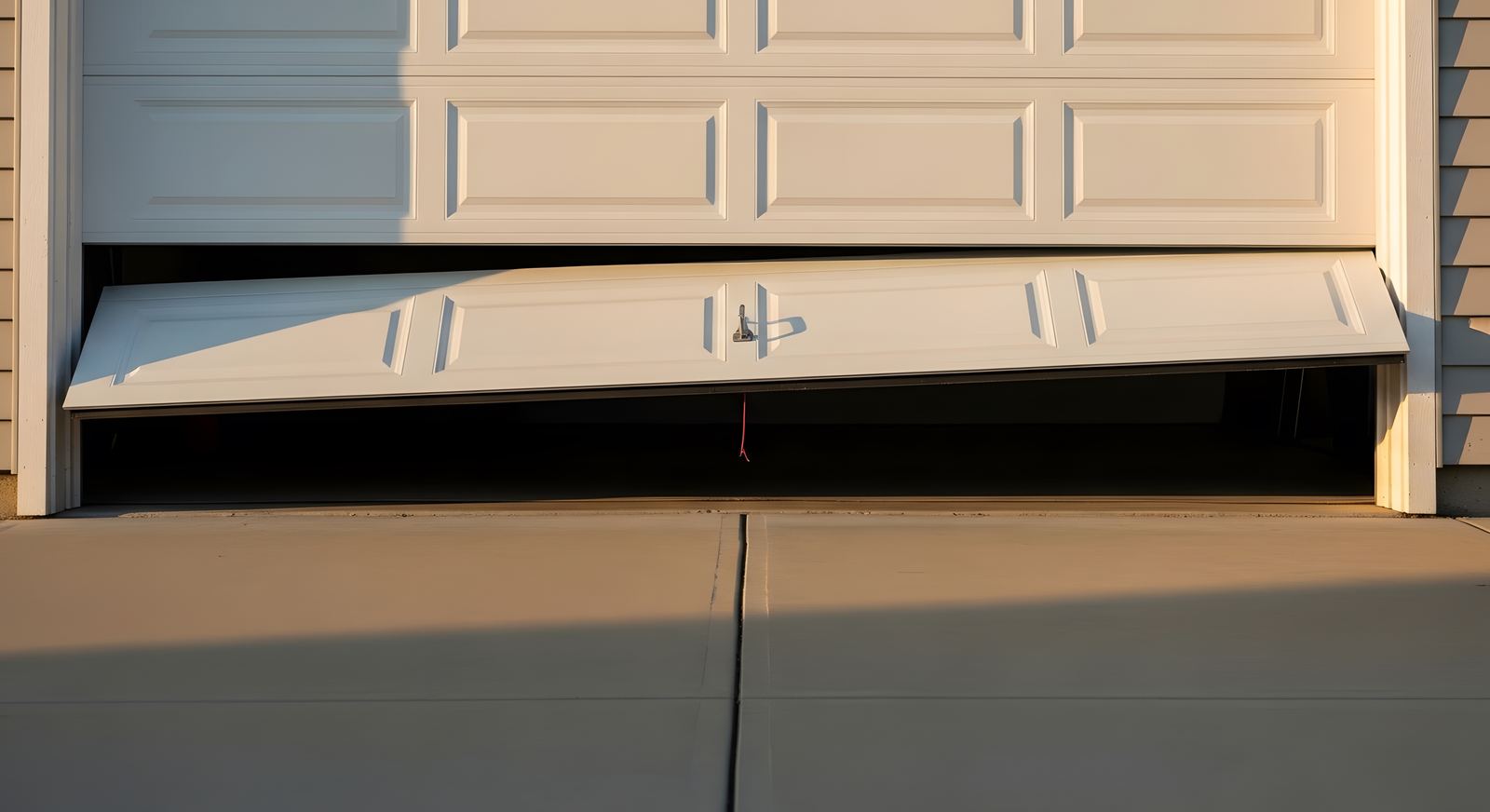
An off-track door usually announces itself. The door sits crooked in the opening or hangs at an angle mid-travel; one or more rollers are visibly outside the track channel, with a panel edge sagging free; the door jams solid at one height and shudders, scrapes, or booms if anything tries to move it; you may see a bent or spread section of track, a gap between roller and rail, or a lift cable hanging slack or tangled off its drum on one side. Sometimes the failure is partial and sneaky: the door still moves but rubs loudly, tilts slightly, or catches at one spot — that is a door in the process of coming off track, and it deserves the same response as one that already has. Take thirty seconds to confirm from a safe distance with a flashlight: count rollers on each side and verify every one sits inside its channel. Do not test-run the opener to see how bad it is; every powered cycle multiplies the damage and the risk.
Honest context, not fear: a sectional garage door weighs roughly 130 to 350 pounds, and in normal operation that weight is carried by rollers captive in steel tracks, lifted by cables, and counterbalanced by springs — a system in equilibrium. Off track, the equilibrium is gone. The door's weight may be resting on a jammed roller, a bent track lip, or partly on the cables in a geometry they were not designed for, and the spring system is still applying full lifting force to a door that can no longer move the way the spring expects. Disturbing that arrangement — running the opener, yanking the door, pulling the emergency release at the wrong moment — can shift the load suddenly: panels fold, the door slides down the opening, cables jump drums and whip, or the track tears off its brackets. This is why technicians secure an off-track door before touching anything, often clamping tracks and supporting the door's weight first. Your job is simpler and just as important: freeze the scene, keep people and pets away from the opening, and do not park anything under or near it.
Knowing the cause matters, because a proper repair fixes it and a rushed one leaves it. The leading cause is impact — a car bumper nudging the door, or backing into it, bends track or pops rollers; even a light tap that seemed like a non-event can spread a track enough that the door derails cycles later. Second is a broken or slipped lift cable: when one cable lets go, the other side keeps lifting, the door racks diagonally in the opening, and rollers lever out of their channels. Third is worn hardware finally failing — rollers with collapsed bearings or cracked wheels that wobble until one exits at the track's curved section, or loose track brackets that let the rail flex away from the wall. Fourth is horizontal track misalignment, where the two overhead rails have drifted out of parallel from loose hangers. And underlying many cases is a door out of balance from tired springs, which loads every other component beyond its design. A good technician re-tracks the door and addresses the cause; ask specifically what let it happen.
Yes — containment, which is genuinely useful. Unplug the opener from its ceiling outlet so nobody operates the door out of habit or from a car remote; this is the single most protective act available and takes ten seconds. If the household uses a smart opener app, disable or warn everyone off it. Keep children, pets, and vehicles away from the opening — move cars out only if the door is fully and stably open, and if it is not, leave them. Photograph everything from a safe distance: the derailed rollers, the track condition, cable positions at both drums, and the door's overall posture — useful for the technician and for an insurance claim if a vehicle strike caused it. If the door is stuck partially open and weather or security is a concern, resist improvising props under it unless a panel is clearly descending; a poorly placed prop can shift the load. What not to do: do not pull the red emergency release on a jammed, racked door — releasing the trolley can let the door's weight shift suddenly — and do not try to hammer track or lever rollers back in.
Worth knowing so you can judge the work. A competent technician starts by securing the door: clamping locking pliers or clamps onto the tracks and supporting the door's weight so nothing can move unexpectedly, and relieving or managing spring tension if the situation requires it. Then they diagnose the geometry: which rollers left the track, whether cables are seated on their drums, whether track sections are bent, spread, or torn from their anchors. The repair proper involves returning the door to true — re-seating rollers into the channel with the door's weight controlled, re-seating or replacing cables, straightening or replacing damaged track sections (bent track is often replaced rather than bent back, since work-hardened steel does not return to spec), tightening or relocating brackets and hangers, and replacing failed rollers and hinges. Then the crucial finish: verifying door balance (the hand-lift test), setting opener travel and force, and running the reversal safety test. Expect the visit to run one to a few hours depending on damage. Ask them to walk you through the root cause before they leave.
Largely, yes — off-track failures are usually the last domino of neglect or impact, and both are addressable. Give the door a two-minute monthly look: watch a full cycle for tilting, hesitation, or new scraping; glance at both cables for fraying and full seating on their drums; check that rollers spin rather than skid. Twice a year, lubricate rollers, hinges, and springs with silicone or lithium spray and snug visible track-bracket and hinge bolts (leave anything attached to cables or springs alone). Test balance quarterly: with the opener released and the door closed, lift it halfway by hand — it should stay put; a sinking door has tired springs that overload everything downstream, so book spring service before it cascades. Guard against impact: a stick-on parking target or hanging tennis ball ends the bumper-nudge failure mode. And if your rollers are original steel units past age ten, upgrading to sealed-bearing nylon rollers during any service visit buys quieter operation and wheels far less likely to collapse and derail.
Give it a careful look before trusting it. Impacts spread track and crack roller stems in ways that fail cycles later, not immediately. Watch one full cycle from inside: any new scraping, tilting, or hesitation at one height means stop and get an inspection. Check the struck panel and nearby track for dents and verify every roller sits fully in its channel.
No — resist the tutorial videos. Re-seating a roller means moving a door section while the springs still apply full lifting force and the cables hold partial load; if the geometry shifts, the door can fold or drop faster than you can react. Technicians clamp and support the door before re-tracking. The repair is quick and routine for them precisely because they secure it first.
Usually a component quietly failed first: a lift cable frayed through or jumped its drum, a worn roller bearing collapsed, or loose track brackets let the rail flex out of position. Tired springs that leave the door unbalanced accelerate all three. The repair visit should identify and fix that root cause, not just re-seat the rollers — ask specifically.
Treat it as no. A racked or partially derailed door binds unpredictably, and hand-forcing it can pop more rollers out or shift weight onto a single cable. Leave it at whatever position it is stuck in, unplug the opener, keep the area clear, and let the technician bring it down under control with the tracks clamped.
Talk to a local garage-door pro now. Free to call, no obligation, honest answers — the way it should be.