Everything a Rhode Island homeowner should know before hiring garage-door help: who's required to hold a license, how to verify one, what the codes say, and which local pages cover your city. One call connects you with an independent local pro: (888) 830-7442.

Rhode Island requires anyone performing residential construction work โ including garage door installation, repair, and replacement โ to register with the state Contractors' Registration and Licensing Board (CRLB), part of the State Building Office. Registration is mandatory for contractors and subcontractors working on one- to four-family dwellings, and it requires proof of liability insurance, completion of pre-registration education requirements, and payment of registration fees; the CRLB can discipline registrants and helps resolve homeowner claims. Registration is a consumer-protection credential rather than a trade-competency license, but working without it is a violation subject to fines. Separately, Rhode Island licenses specific trades โ electrical work for opener circuits must be done by a licensed electrician. Homeowners should confirm a garage door company's registration number, which contractors are required to include in advertising and contracts, using the CRLB's online lookup before hiring, and verify the registration is active and matches the business name on the written contract.
Verify before you hire: RI Contractors' Registration and Licensing Board Registration/License Status Lookup. It takes a minute, it's free, and it's the single strongest scam filter available to a homeowner.
Rhode Island's state building code is administered through local building officials in each city and town. A same-size garage door replacement is commonly treated as repair work, but many Rhode Island communities require a building permit when the door or its framing is replaced, and a permit is clearly required when an opening is enlarged, a header is changed, or structural work is done. Electrical permits apply to new opener wiring. Because coastal wind provisions can affect product selection, checking with the local building department first is standard practice.
Rhode Island's residential code (RISBC-2, based on the 2018 International Residential Code with state amendments) sets ultimate design wind speeds that rise toward the coast, and southern coastal communities โ including areas of Washington and Newport counties and Block Island โ fall in higher wind zones with wind-borne debris provisions near the shoreline. Garage doors, as the largest opening in a home, must be rated and labeled for the design wind pressures of the site. In coastal zones, installers typically specify wind-load-reinforced doors with heavier tracks and additional fasteners, and replacement doors should carry a design-pressure label appropriate to the exposure.
Rhode Island combines a cold coastal winter with hurricane-season wind exposure. Salt air along Narragansett Bay and the south shore corrodes springs, cables, hinges, and track hardware faster than inland norms, making rust the leading long-term failure driver in coastal towns. Freeze-thaw cycling and winter cold snaps embrittle torsion springs, producing a late-winter spike in spring failures, and nor'easters drive wind-blown rain and salt spray against seaward-facing doors. Humid summers add condensation inside garages. Coastal homeowners benefit from corrosion-resistant hardware, regular fresh-water rinsing of exterior hardware, and lubrication schedules more frequent than inland recommendations.
In Rhode Island, the garage door is a structural decision, not just a convenience. Wind events find the largest opening in the house first, and a door that fails lets pressure inside the envelope โ the failure mode FEMA documents as a leading cause of catastrophic roof loss.
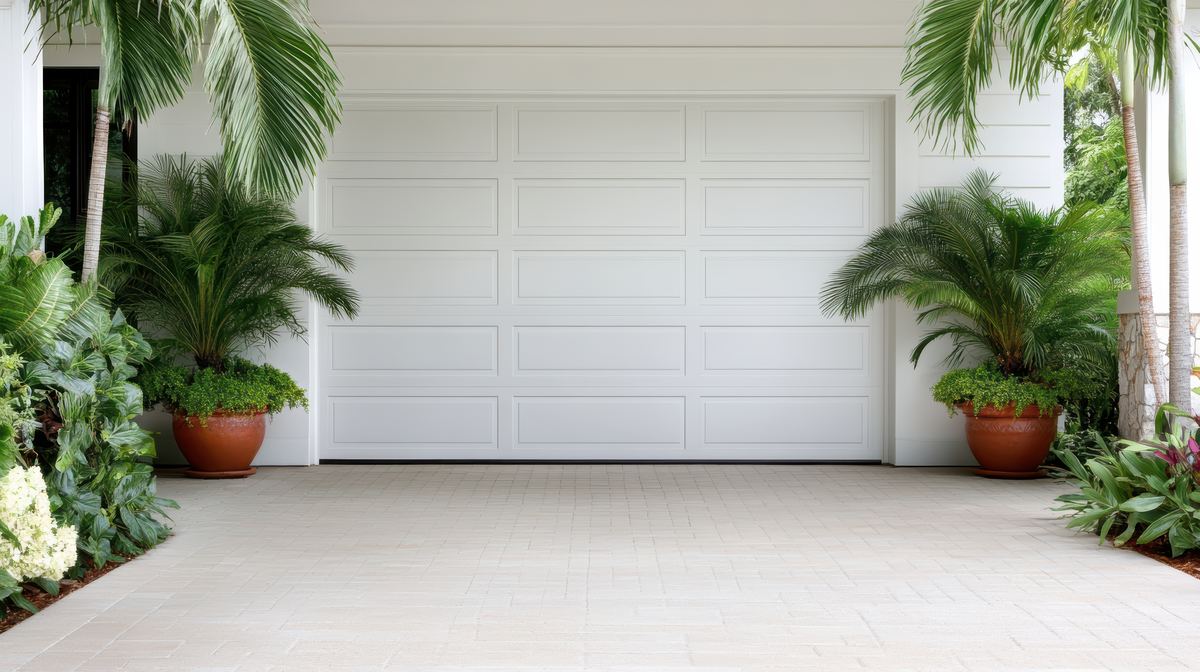
Your Rhode Island garage door answers to Washington โ specifically, to a rule written in 1992. Since January 1, 1993, every residential opener sold in the U.S. must reverse automatically on contact with an obstruction โ entrapment protection required by UL 325 and 16 CFR Part 1211, standards written after documented child entrapment deaths.
Verify it in under a minute: interrupt the sensor beam mid-close (it should reverse), then the lumber test on the floor (contact must reverse it). Failing either puts the door outside a federal standard written after documented tragedies โ and a local pro can bring it current, often the same day.
Sources: U.S. Consumer Product Safety Commission ยท UL Standards & Engagement ยท 16 CFR Part 1211 ยท DASMA
This industry's fake-storefront problem is real enough that search engines purge garage-door listings in waves. Five minutes of checking beats a driveway dispute every time.
Start with RI Contractors' Registration and Licensing Board Registration/License Status Lookup. A current credential is the baseline โ not proof of quality, but its absence is disqualifying in a state that requires one. Ask for the number over the phone; legitimate companies volunteer it.
Parts named, labor separated, warranty terms in writing โ before work begins. The signature scam in this trade is the advertised teaser fee that balloons on the driveway; a written quote is its natural enemy.
General liability and workers' comp protect you if a spring job goes wrong on your property. Reviews can be manufactured; certificates of insurance are harder to fake and any established Rhode Island outfit can produce one.
Fake garage-door listings borrow retail addresses and virtual offices. Map the address you're given. A service-area business with no storefront can still be legitimate โ but it should say so plainly rather than borrowing someone else's building.
Deposits are normal for custom doors; full prepayment for a repair is not. Standard practice in Rhode Island is payment on completion โ and a pro confident in their work has no reason to ask otherwise.
Every call type routes to an independent local professional โ ordered here by what Rhode Island's climate actually breaks first.
Wind-load rated doors where codes require them โ and where storms don't care about codes.
Learn more โBig ticketSteel, wood, insulated, modern glass โ full replacement quoted with the door in front of them.
Learn more โMoney callThe loud bang and a door that won't lift. Torsion and extension springs โ the one repair pros exist for.
Learn more โOpenersDead motor, blinking lights, no response. All major brands, diagnosed honestly.
Learn more โCables & tracksFrayed cables, bent track, worn rollers โ the parts that keep a door moving straight.
Learn more โOff-trackHanging crooked or jumped the rails? Don't force it โ that multiplies the damage.
Learn more โPanelsOne dented section doesn't have to mean a whole new door โ when panels are still made.
Learn more โ24/7Stuck open at midnight is a security problem. Off-hours routing to someone who answers.
Learn more โCommercialRolling steel, dock doors, and gate operators for shops, warehouses, and lots.
Learn more โWeatherproofingBottom seals, thresholds, and insulation that keep weather and critters out.
Learn more โTune-upThe annual once-over that catches wear before it becomes an emergency.
Learn more โSmartWi-Fi openers, keypads, and phone control installed and paired correctly.
Learn more โIn our 39-state Garage Door Failure Risk Index, Rhode Island ranks #15 of 39 with an index score of 55.2. The median Rhode Island home was built in 1969 โ before the 1993 federal auto-reverse requirement, which means a meaningful share of openers here were never covered by the modern entrapment standard. About 63.0% of occupied homes are owner-occupied โ and owners, not landlords, make the maintenance decisions that keep doors alive.
The Rhode Island calendar bends around storm season. Late spring is preparation time: wind-rating checks, bracing hardware, and seal inspections before the season peaks. During storm months the emergency calls run to doors that failed under pressure or lost power mid-cycle โ battery-backup openers earn their keep here. The cooler months are the window for the structural work: rated-door replacements and reinforcement retrofits are far easier to schedule when the forecast is calm, and installers' calendars agree.
The biggest Rhode Island markets we cover, with the full city list below. Each page carries local housing data, the free checks, and direct routing to a pro serving that area.
| City | Covered population | Median home built | ZIPs |
|---|---|---|---|
| Providence | 219,179 | 1938 | 12 |
| Warwick | 77,409 | 1960 | 4 |
| Pawtucket | 75,300 | 1947 | 3 |
| Cranston | 72,411 | 1961 | 3 |
| Woonsocket | 43,081 | 1950 | 1 |
| Cumberland | 36,383 | 1971 | 1 |
| Coventry | 33,246 | 1970 | 1 |
| West Warwick | 31,025 | 1967 | 1 |
| Johnston | 29,473 | 1971 | 1 |
| Newport | 25,029 | 1938 | 2 |
Rhode Island requires anyone performing residential construction work โ including garage door installation, repair, and replacement โ to register with the state Contractors' Registration and Licensing Board (CRLB), part of the State Building Office. Use the official lookup to verify before hiring.
Use RI Contractors' Registration and Licensing Board Registration/License Status Lookup โ the official lookup. A legitimate company will volunteer its credential number; hesitation is an answer too.
Rhode Island's state building code is administered through local building officials in each city and town. A same-size garage door replacement is commonly treated as repair work, but many Rhode Island communities require a building permit when the door or its framing is replaced, and a permit is clearly required when an opening is enlarged, a header is changed, or structural work is done. Electrical permits apply to new opener wiring. Because coastal wind provisions can affect product selection, checking with the local building department first is standard practice.
In Rhode Island, the garage door is a structural decision, not just a convenience.
Talk to a local garage-door pro now. Free to call, no obligation, honest answers โ the way it should be.