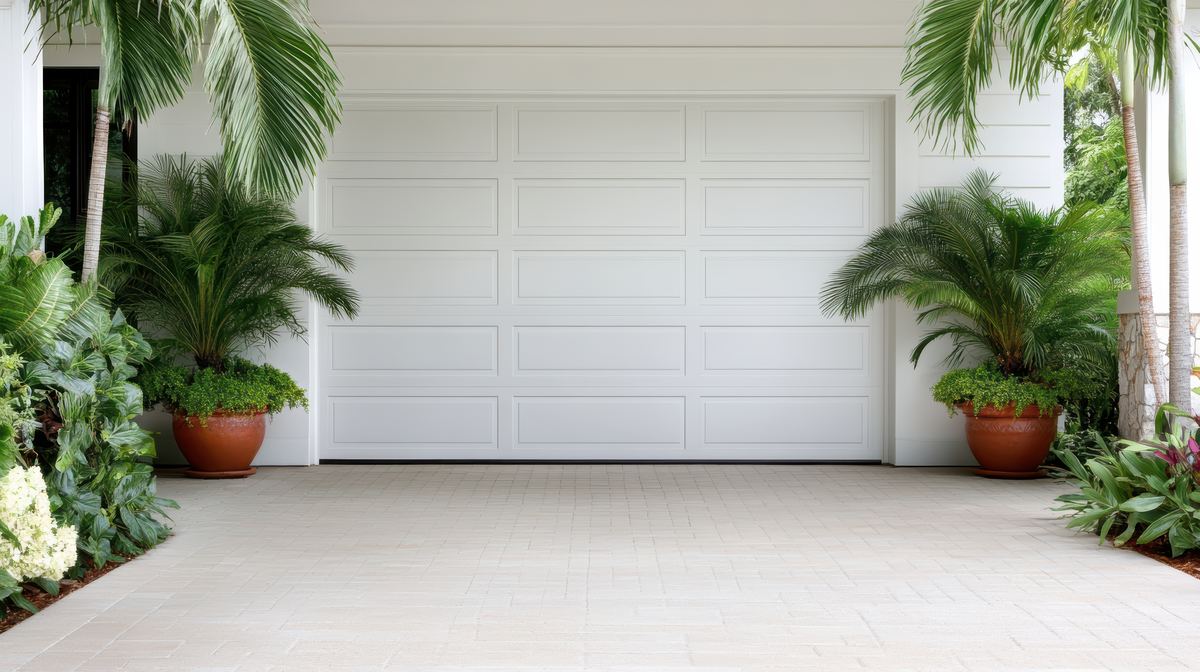
Why is the garage door the weak point in a hurricane?
Geometry and physics conspire against it. The garage door is usually the largest single opening in a home's envelope — a wide, thin, flexible diaphragm of hinged panels spanning eight to sixteen feet with support only at its edges — and wind load scales with area, so the biggest opening collects the biggest force. Standard doors flex under pressure until panels buckle inward, rollers pop from their tracks, or the whole assembly blows in; wind-driven debris accelerates the process. What happens next is the part FEMA's post-storm investigations have documented repeatedly since Hurricane Andrew in 1992: once the door fails, wind enters the garage and pressurizes the building from within, and that internal pressure adds to the suction already pulling upward and outward on the roof and walls. The combination is how homes lose roofs — the failure begins at the garage door and propagates through the structure. This is why modern coastal building codes treat the garage door not as a convenience item but as a structural component of the building envelope, and why a wind-rated door is one of the highest-leverage hardening investments a coastal homeowner can make.
What do wind-load ratings actually mean?
A wind-rated door is engineered and tested to resist specified design pressures — expressed as positive pressure, wind pushing the door inward, and negative pressure, suction pulling it outward as wind wraps the building. Those design pressures are calculated for your specific situation, not read off the door's sticker alone: the governing wind speed for your location under the building code, your exposure category (open terrain versus sheltered suburb), the height of the building, and the size of the door opening all feed the required numbers, which is engineering work your installer or the door manufacturer performs against the local code. The door achieves its rating through visible engineering: heavier-gauge panel skins, reinforcing struts across sections or integrated post systems, upgraded rollers and hinges, deeper and stronger track, and — critically — more and beefier attachment points into a properly built opening, because a strong door lagged into weak framing fails at the framing. A separate concept rides alongside: impact resistance, proven by large-missile testing in which a lumber projectile is fired at the door, followed by pressure cycling. Wind pressure ratings and impact ratings are distinct certifications; coastal debris zones typically demand both, and an honest installer explains which your jurisdiction requires.
What are Florida's HVHZ and Miami-Dade approvals?
Florida operates the strictest wind-borne debris regime in the country, and its vocabulary is worth knowing even beyond Florida because it functions as a national benchmark. The High-Velocity Hurricane Zone — the HVHZ — covers Miami-Dade and Broward counties, where the Florida Building Code imposes its most severe requirements. Products used there need formal approval: a Miami-Dade Notice of Acceptance, the NOA, certifies that a specific door assembly passed the county's testing protocols — pressure testing, large-missile impact, and cyclic loading that simulates hours of gusting — as a complete system of panels, track, hardware, and fasteners. Statewide, the Florida Product Approval system serves the same gatekeeping role outside the HVHZ. Two practical consequences matter to a buyer. First, the approval belongs to the entire tested assembly installed per its documents — substituting track, struts, or fasteners, or anchoring into inadequate framing, voids the engineering even if the panels are genuine. Second, because Miami-Dade's protocol is famously demanding, an NOA-holding door is widely treated as a premium credential in every hurricane-exposed market from Texas to the Carolinas. Permits and inspections apply in these jurisdictions, and the installers we refer for this work handle that documentation as part of the job.
Can my existing door be reinforced, or do I need a rated door?
Both paths exist, and the honest answer depends on your code situation and your door's condition. Retrofit reinforcement — typically vertical bracing systems that anchor the door's sections to the header and the slab, sometimes with added horizontal struts on the panels — can meaningfully stiffen an existing door against pressure, and FEMA's homeowner hardening guidance has long listed garage door reinforcement among its recommended retrofits. The limits deserve equal billing: a retrofit braces the panels but does not transform the door into a certified assembly — it typically adds no impact rating, its performance depends on the door and framing it attaches to, and in jurisdictions like the HVHZ it does not substitute for an approved product where one is required. Some bracing systems also must be manually deployed before a storm, which means their protection depends on somebody being home and able. A rated replacement door wins decisively when: your door is aging anyway, your jurisdiction requires certified product for replacements, you want impact protection as well as pressure resistance, or you want the certification to show your insurer — wind-mitigation credits for rated openings are a real conversation in coastal states, worth having with your carrier. A qualified installer can assess your door, framing, and local code and lay out both paths without drama.
What should I expect from a wind-rated door installation?
More engineering rigor than a standard door swap, visible at every step. It starts with determining the required design pressures for your opening — from local code wind maps, exposure, building height, and opening size — and selecting a door assembly whose certification meets or exceeds them, with impact rating where the debris zone requires it. The opening itself gets evaluated next, because rated doors are only as strong as their anchorage: the jambs and header must be adequate structural members properly tied into the wall, and older openings sometimes need framing reinforcement before the door goes in — a legitimate scope addition, not an upsell, and the step that separates real protection from paperwork. Installation then follows the certification documents precisely: the specified track, struts, brackets, and fastener schedule, torqued into the specified anchorage, because the approval covers the tested configuration and nothing else. In permit jurisdictions, expect plans, the product approval documents, and an inspection as part of the process. The finish work matches any quality installation — springs sized to the heavier rated door, balance set, opener capacity verified, safety systems tested — plus the paperwork handoff: keep the approval documents and permit records, which matter for insurance, resale, and any future service on the door.